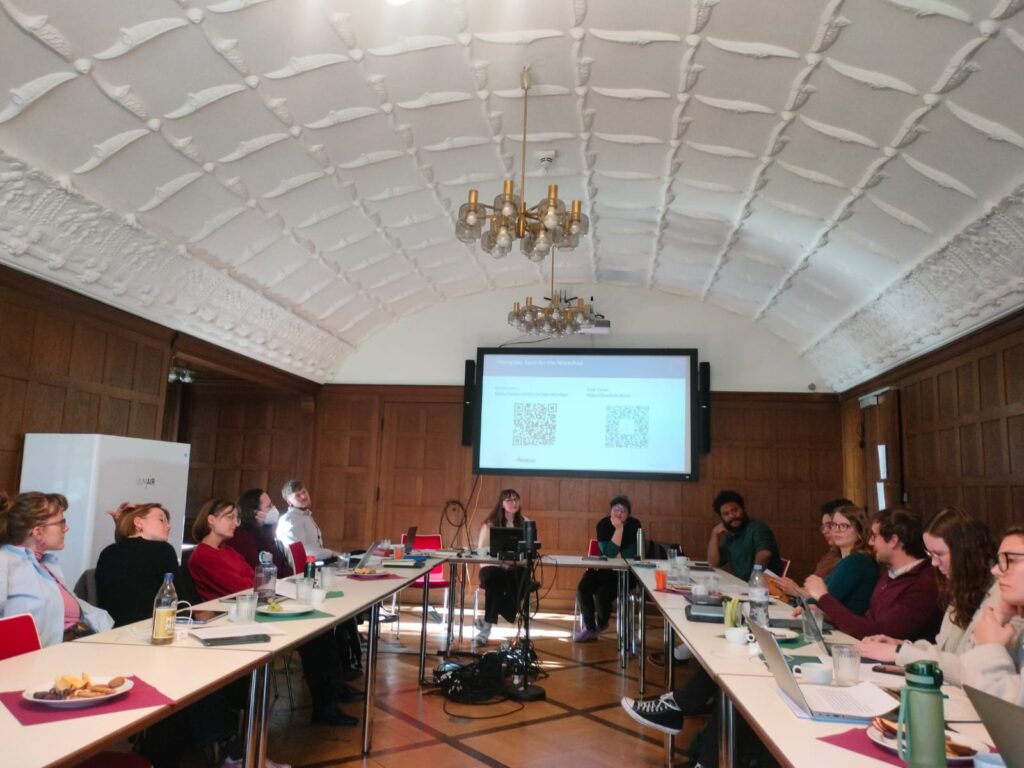
In April 2026, MIDA (Modern India in German Archives, 1706–1989) organized a two-day workshop with the title “Violent Entanglements – Tracing Life and Loss in Colonial Archives”.
Abstract
From the fifteenth century onward, European colonial expansion was inseparable from practices of documentation, classification, and record-keeping that rendered territories, peoples, and nonhuman life legible to imperial regimes, giving rise to colonial archives. Far from neutral repositories, these archives functioned as epistemic instruments that enabled extraction, dispossession, and domination, while simultaneously obscuring the physical violence through which they were continuously produced and reproduced. The records preserved today—textual, audio-visual, oral, botanical, zoological, and digital—bear the traces of these processes, registering not only administrative control and scientific ambition, but also loss, displacement, extinction, and erasure. At the same time, colonial archives remain deeply ambivalent sites: while they have historically stabilized unequal power relations and marginalized non-dominant forms of knowledge, they also contain the documentary conditions through which past injustices can be traced, contested, and made visible.
In this workshop, we use violence as an analytical lens to explore the ethical, epistemological, and historiographical challenges of working with archival remains that are inseparable from colonial domination yet continue to structure contemporary research practices. By attending to materiality, sensory experience, spatial design, and archival mediation, this workshop also opens possibilities for critically reimagining the archive beyond its colonial legacies. During the workshop, we will have group discussions on published articles that are provided via a reader beforehand to further our understanding of the inextricable entanglements of archives, colonialism and violence we encounter in archival research.
You can find more information and the programme here.
Report
Conceived as a reading workshop, the event brought together students from the Master’s Programme Global History, researchers from different disciplines, and invited guests—Marika Cifor (University of Washington), Mallika Leuzinger (ZMO), Catarina Madruga (TU Berlin), and Christian Stenz (University of Heidelberg)—for two days of lively discussions. Structured across four sessions, the workshop critically engaged with key strands of literature on colonial archives, materiality, affect, and the ownership of Indigenous knowledge and heritage in contemporary archival contexts. Rather than approaching archives as neutral repositories, discussions foregrounded their role as active sites of knowledge production, shaped by colonial power relations, classificatory practices, and epistemic hierarchies.
The first session focused on the colonial archive as a site of knowledge production and power, emphasizing how archives and museums are embedded in hegemonic structures and may reproduce colonial logics through classification, naming, and access. A central insight was that the logistical and political conditions of access—such as resources, institutional frameworks, and archival infrastructures—can themselves constitute forms of violence, determining who is able to engage with archival materials and whose histories remain visible. Participants also reflected on the multiplicity of archives and the existence of silences, stressing that not all experiences enter the archive and that some materials remain unused or disappear over time challenging assumptions about completeness and neutrality.
The second session turned to the status and agency of archival objects and their shifting status within archival and museum contexts. Participants explored how archival materials move between states of usefulness and neglect shaped by processes of maintenance, decay, and reinterpretation. These transitions were understood not as passive outcomes, but as dynamic processes raising questions about material agency: how does the materiality of archival documents shape social relations, temporalities, and knowledge practices? Participants emphasized that usefulness is neither inherent nor stable, but emerges relationally—through institutional frameworks, archival practices, and broader constellations of power and meaning. Colonial histories of collecting, classification, and archiving were discussed as ongoing violent configurations of power that need to be addressed by the researchers engaged with the archives’ material.
The third session addressed the experiential and affective dimensions of archives, foregrounding how spatial arrangements, institutional settings, and embodied encounters shape researchers’ relationships to archival materials. The reading room emerged as a political space, where access, distribution, and the organization of materials influence both interpretation and emotional response. Participants emphasized that experiences of archives are diverse and situated, shaped by positionality as well as by the broader structures governing public and private institutions, which in turn affect how knowledge is produced and understood. Questions of who accesses archives, under what conditions, and with what emotional and epistemic consequences, were central to these conversations.
The fourth and final session deepened the workshop’s engagement with affect, displacement, and ethics. Building on concepts of radical empathy and Indigenous archival futures, participants examined “displaced archives”—records removed from their places of creation—and the power dynamics embedded in their continued custodianship, with particular attention to the Migrated Archives and the bureaucratic violence of colonial state practices. Discussions of Indigenous-led archival futures emphasized self-determination, Indigenous Cultural and Intellectual Property (ICIP), as well as the tensions inherent in conducting research within Western academic frameworks. The session also addressed the promises and limits of digitization—described as a form of “cruel optimism”—alongside emerging participatory and visual archival practices that reconfigure access, authority, and the very meaning of the archive.
Across all four sessions, the notion of violent entanglements proved a productive analytical lens. It captured not only the historical violence embedded in colonial archives, but also the ongoing entanglements between material objects, knowledge systems, and contemporary research practices. Participants reflected on the extent to which researchers themselves may either reproduce or actively challenge these dynamics through their own methods and interpretive choices.
The workshop concluded with a discussion on the aims and formats of future collaborative work, emphasizing the value of interdisciplinary exchange and collective reflection. By bringing together perspectives from history, archival studies, and related fields, Violent Entanglements created a space for critically rethinking the archive—not as a static site of preservation, but as a dynamic field of material, affective, and epistemic relations, whose entanglements with colonial power remain very much alive.